
OSHA’s basic recordkeeping rule (29 CFR Part 1904) still applies. Employers in most industries with more than 10 employees must record any work-related injury or illness that meets the OSHA recordability criteria. Each qualifying case is logged on OSHA Form 300 (in 2025, a separate OSHA Form 301 or equivalent was used to document each incident). At year’s end, employers fill out OSHA Form 300A to summarize totals (number of injuries, days away, etc.). The OSHA 300A must be certified by a company executive and posted visibly from Feb 1 through April 30 of the following year.
For 2026 specifically, OSHA did not adopt any new recording columns or definitions. (A pending rule to add a musculoskeletal disorders (MSD) column was withdrawn in 2025.) The key change in recent years has been electronic reporting of injury data. Under OSHA’s electronic reporting rule, certain employers must submit the data from Form 300A (and in some cases Forms 300/301) each year via OSHA’s Injury Tracking Application (ITA). Covered establishments include:
- Those with 250 or more employees in industries that normally keep OSHA injury logs.
- Those with 20 to 249 employees in specifically designated high-hazard industries (see OSHA’s Appendix A to 29 CFR 1904).
- In addition, establishments with 100 or more employees in certain industries must submit detailed case data from Forms 300 and 301 (as per OSHA’s Appendix B).
Exempt industries (e.g., many white-collar firms) are listed in OSHA’s regulations and are not required to record illnesses or submit data. Also, employers with 10 or fewer total employees are generally exempt from keeping OSHA logs.
Who Must Comply & What to Report
- Maintain injury logs: All covered employers must record recordable cases on Forms 300/301. (Record any work-related fatalities, injuries or illnesses requiring more than first aid.) Record events promptly (generally within a few days).
- Prepare Form 300A: By Feb 1 of each year, complete the OSHA 300A summary for the prior year and get it certified by a company executive. It must be posted in the workplace (Feb1–Apr30).
- Determine reporting requirement: Use OSHA’s ITA Coverage App or Appendix listings. If your site meets the size/industry thresholds above, you must submit electronically.
- Submit data: Each employer required to report must file the Form 300A summary data via OSHA’s online portal by the March deadline (for 2025 data, that deadline was March 2, 2026). Larger employers may also have to upload case-by-case details from Forms 300/301.
- Follow record retention: Keep all OSHA logs on file for five years after the year covered (29 CFR 1904.33).
Key Deadlines and Steps (2026 Timeline)
The table below summarizes the main compliance actions and timing:
Record injuries/illnesses on OSHA 300/301 logsOngoing, within days of incidentPer 29 CFR 1904.29–.32; log any case that is work-related and recordable.Determine if electronic submission is requiredASAP after year-endCheck if 100/250+ employees or in designated industries.
| Step & Action | Deadline / Timing | Notes / OSHA Ref. |
|---|---|---|
| Complete and certify OSHA Form 300A | By Feb 1 (for prior year) | Summarize annual cases; must be certified by a manager (29 CFR 1904.32). |
| Post OSHA Form 300A in workplace | Feb 1 – Apr 30 (year-end) | Must be visible to employees and OSHA inspectors. |
| Submit data via OSHA’s ITA | Early March (year following) | e.g. March 2, 2026 for 2025 data. Use OSHA’s portal to upload the summary (and detailed logs if required). |
| Retain OSHA records | 5 years after year-end | Keep all original 300/301 logs, 300A, and related info for five years (29 CFR 1904.33). |
Reporting Requirements & Penalties
Failure to keep accurate logs or to submit required summaries can draw OSHA citations. Violations of recordkeeping rules are enforceable by OSHA as workplace safety violations. OSHA can issue serious or non-compliance citations for incomplete logs or late submissions, with fines in the tens of thousands of dollars (for example, about $16,550 per serious violation and up to $165,514 per willful/repeated violation under the 2026 penalty schedule). Employers should treat OSHA recordkeeping with the same diligence as any safety requirement. Penalties highlight the importance of timely, accurate reporting.
How the HRCPE Webinar Helps
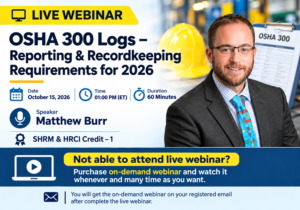
The HRCPE on-demand webinar “OSHA 300 Logs – Reporting & Recordkeeping Requirements for 2026” distills these complex requirements into practical guidance. Led by HR consultant Matthew Burr, this 60-minute session (eligible for SHRM/HRCI credit) covers the latest rules and how to comply. Key topics include:
- Electronic reporting updates: Guidance on the 2026 OSHA 300 Log e-submission system and the newest reporting guidelines.
- Forms and definitions: Detailed walkthrough of OSHA Forms 300, 300A, and 301, and how to properly complete them.
- Recordkeeping nuances: When to record vs. report injuries, first aid vs. medical treatment distinctions, and handling special cases (remote work, hearing loss cases, privacy requests, etc.).
- Compliance best practices: Step-by-step instructions on preparing and posting the annual summary, determining which establishments must submit data, and staying in compliance.
By attending the HRCPE program (live or on-demand), HR and safety professionals can directly ask questions about their own scenarios, ensuring they understand exactly how the OSHA 300 requirements apply to them. The training reinforces official OSHA guidance (29 CFR 1904 and OSHA recordkeeping FAQs) with clear examples and procedural steps.